

Timber floors
Timber floors over hydronic floor heating
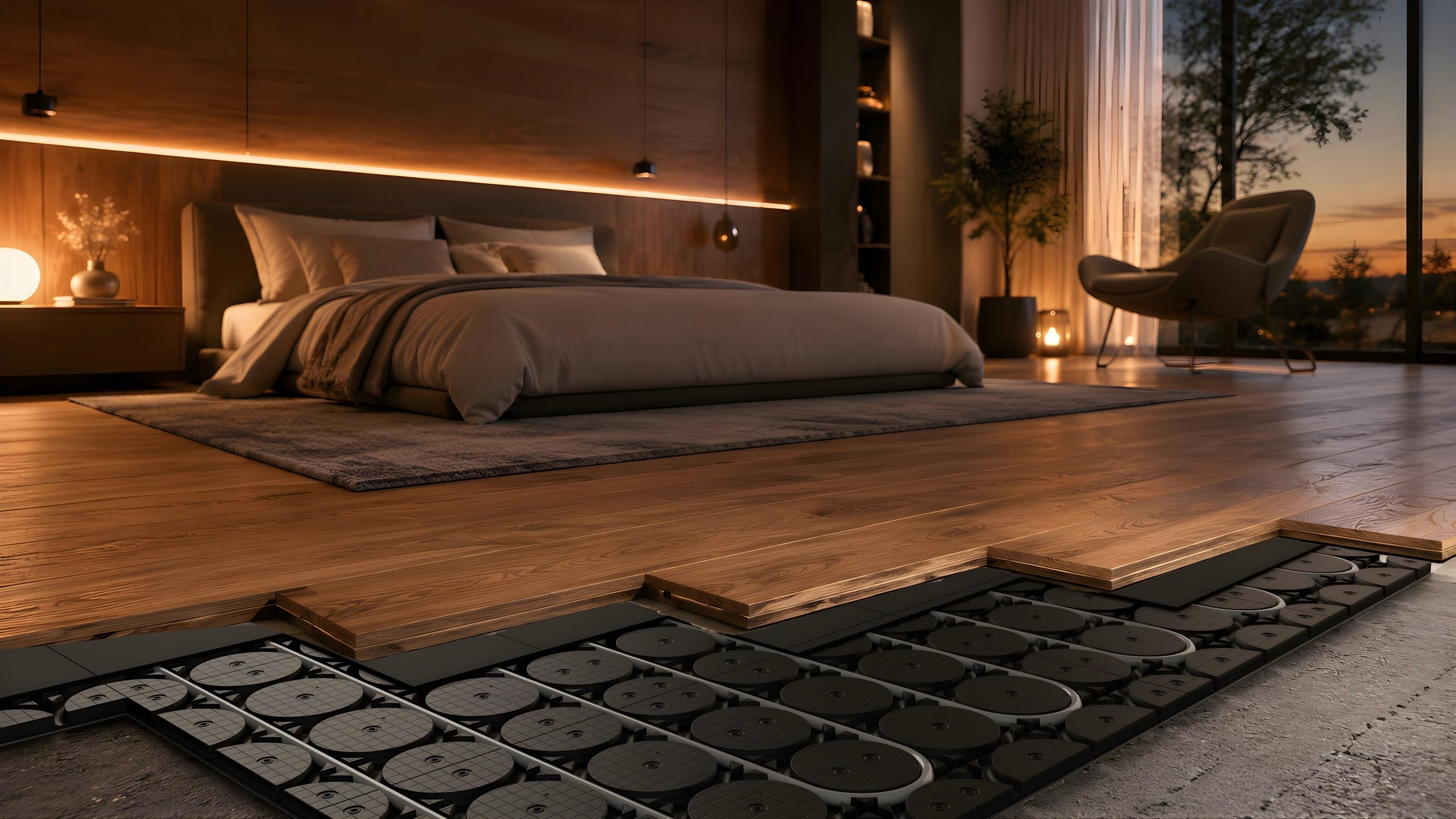
Floating engineered timber laid straight over HOYA Ondol panels. Gentle, even warmth through the boards, with no screed to pour and no glue on the panels.
27 °C at most
on the timber surface
27 °C
44–45 mm
169 mm
35–45 °C

How it feels
Warm underfoot, never hot
The timber surface is kept at or below 27 °C, which is cooler than your skin. So the floor feels gently warm rather than hot, and the warmth is even and comfortable underfoot.
Timber floors over HOYA Ondol are designed for flow temperatures of 35–45 °C, which suits a heat pump.
The boards
Which timber boards can go on top
Engineered oak is the approved choice over HOYA Ondol. These are our timber supplier’s heating conditions; check any other supplier’s own conditions before you order.
- Approved
Engineered oak, 14–15 mm
- Not covered
Eucalyptus-faced boards
- Ask us first
Solid timber
The click joint
How the boards click together
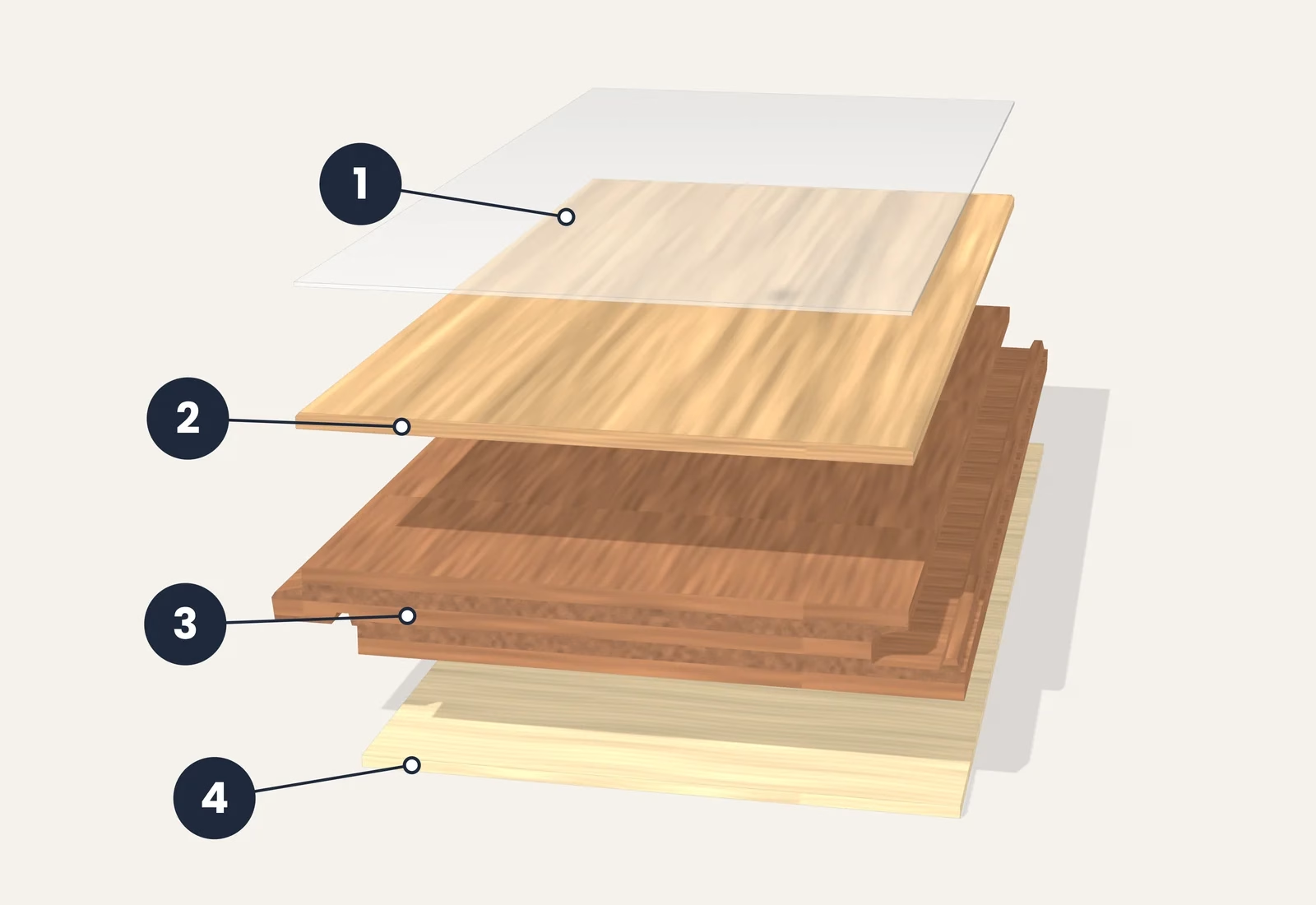
Inside a 14 mm click board
Each board has a 2 mm top layer of European oak on a cross-bonded eucalyptus core, with a birch backing. The core layers run in alternating directions, which helps keep the board flat and stable as the floor warms and cools.
- Ultra-matt factory finish
- European oak top layer, 2 mm
- Cross-bonded eucalyptus core, with the click edges cut into it
- Birch backing
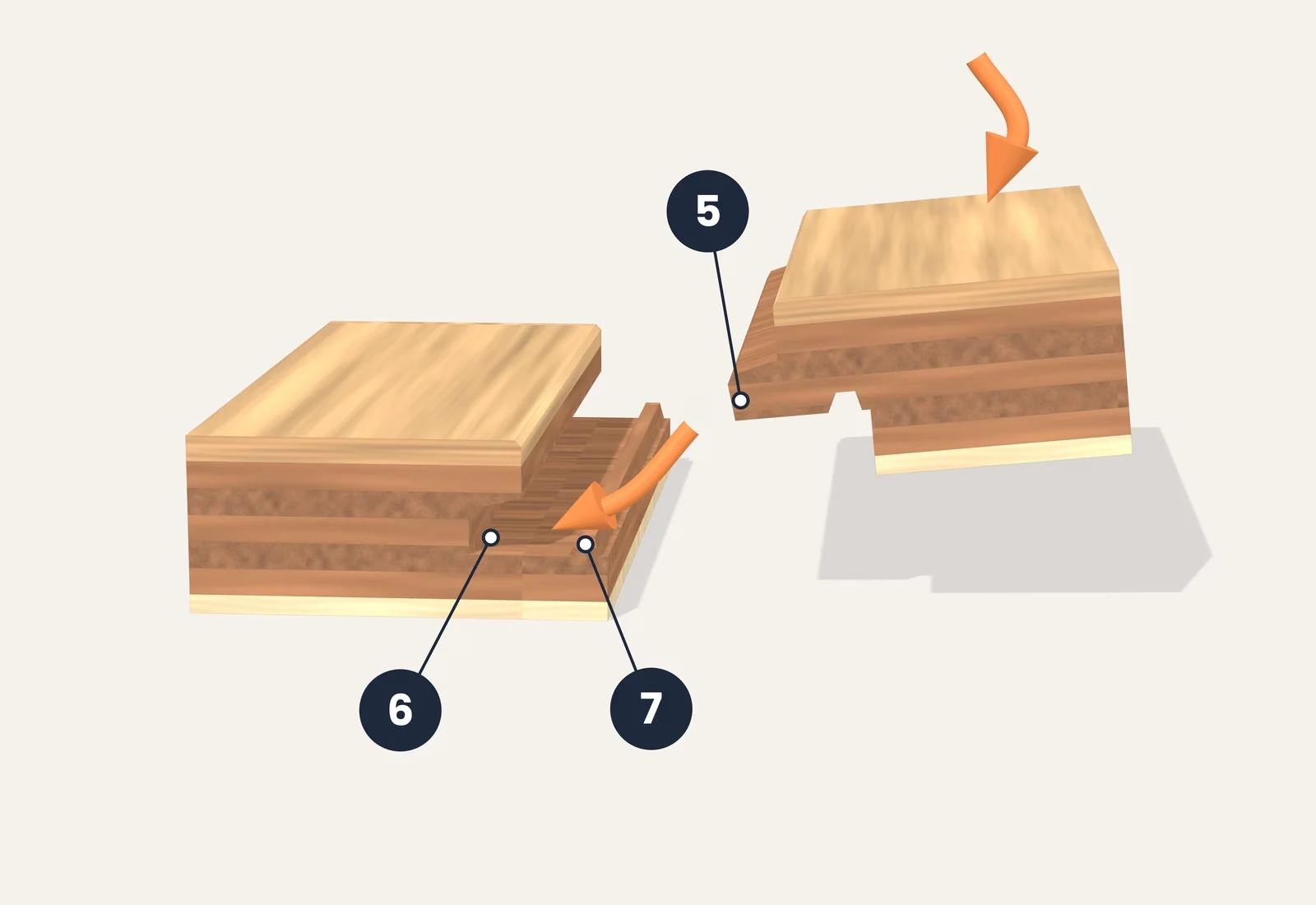
Long side: angle in, press down
Each board is angled into the edge of the board before it, then pressed down flat. The locking strip pulls the joint tight.
- Tongue
- Groove
- Locking strip
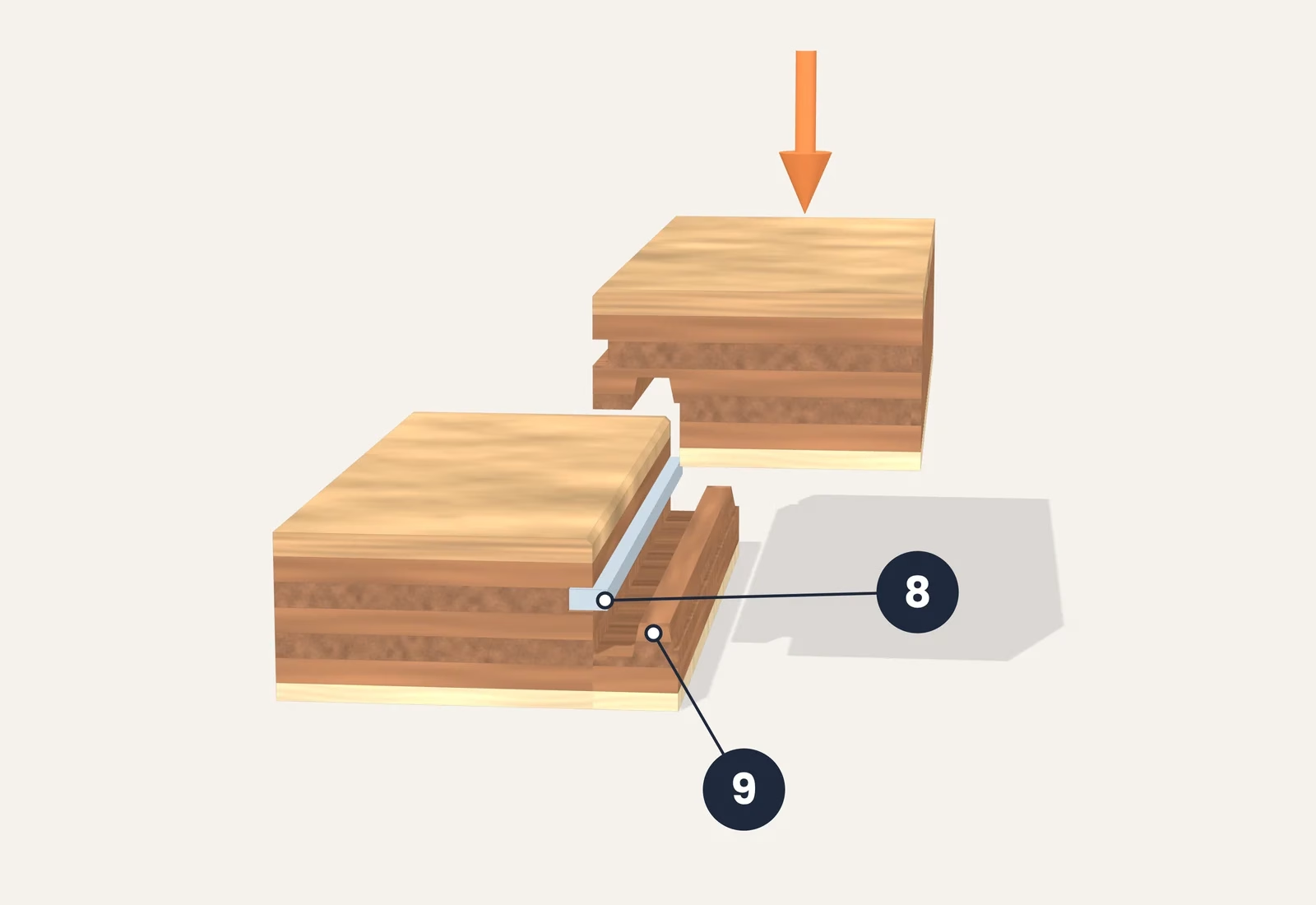
Short end: drop down, click shut
The short end drops straight down onto the end of the last board and clicks shut. The click joints are glued with a cross-linked D3 (or higher) timber flooring PVA.
- Flexible locking tongue
- End locking strip
Drawings are for illustration only and not to scale. Joint shapes vary between board makers, so lay the boards to the board maker’s instructions.
The build-up
How the floor goes together
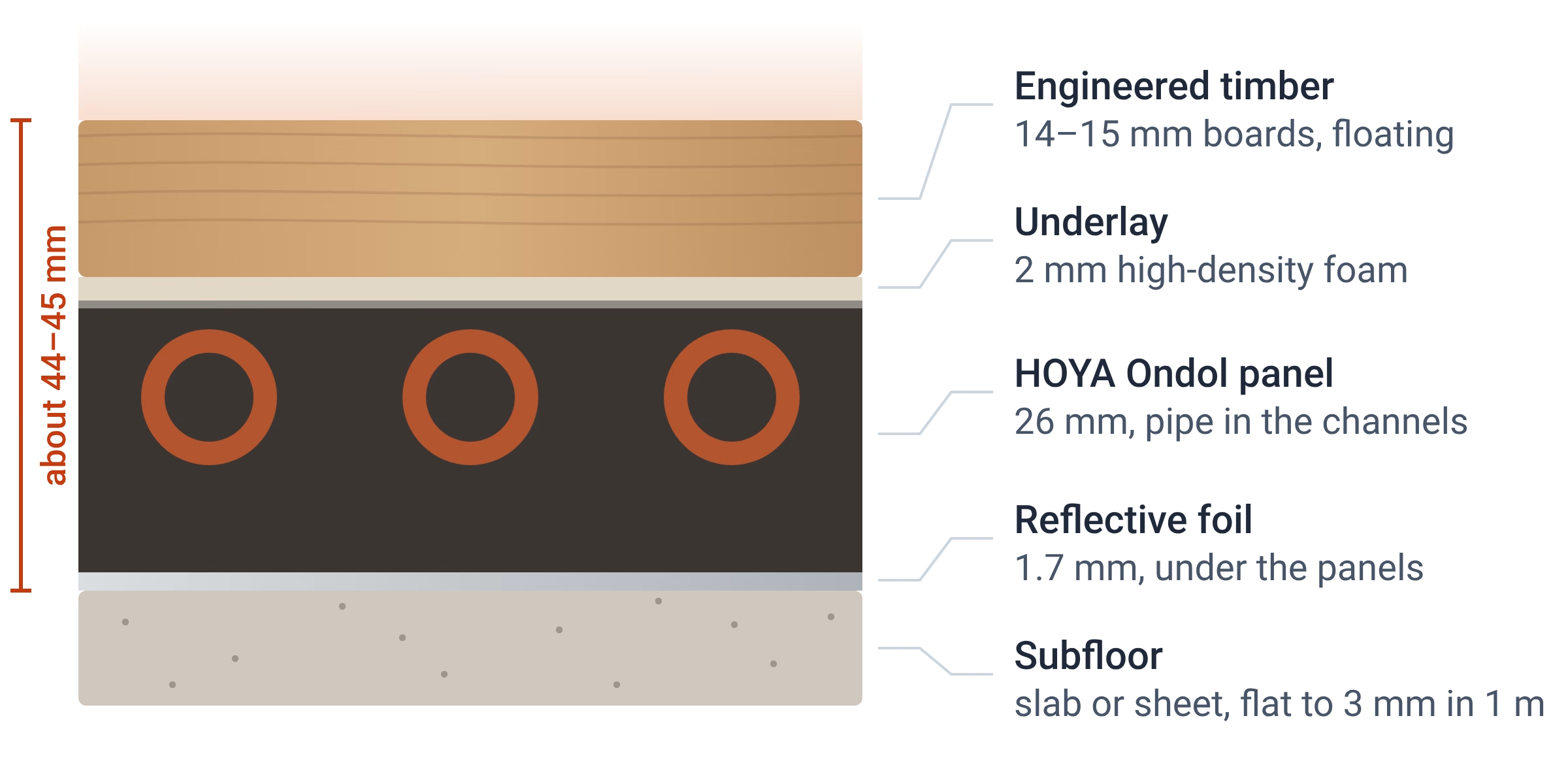
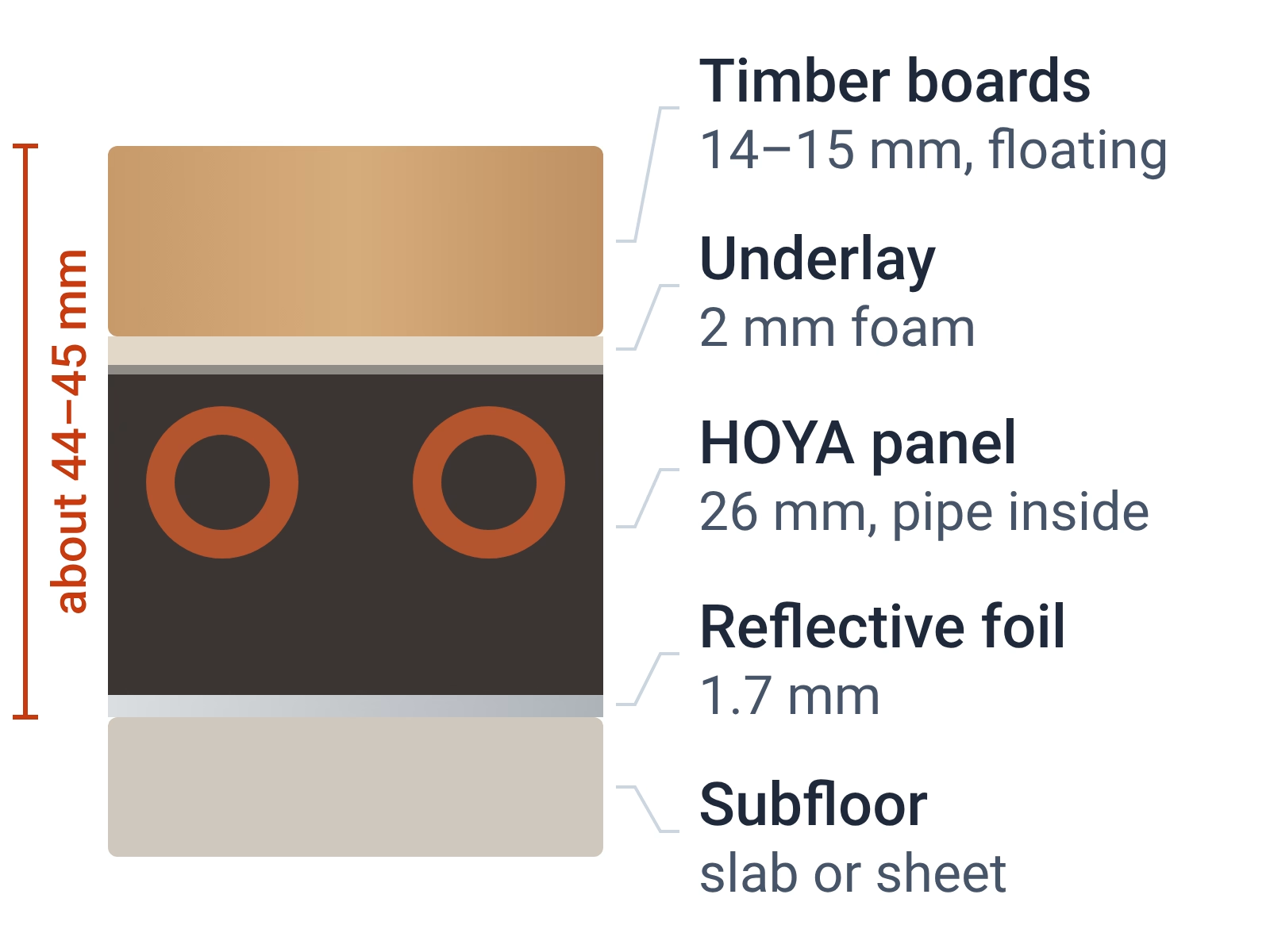
From the subfloor up, a timber floor over HOYA Ondol is about 44–45 mm thick. Nothing is poured and nothing has to cure.
- Subfloor Slab or sheet subfloor, flat to within 3 mm over 1 m
- Reflective foil 1.7 mm, under the panels
- HOYA Ondol panel 26 mm, with the 16 mm PE-RT pipe in its channels under the cover
- Underlay 2 mm high-density foam, acoustic grade
- Engineered timber 14–15 mm boards, floating
- Total 43.7 mm with 14 mm boards, 44.7 mm with 15 mm boards
The timber warranty
What the timber warranty asks, and how a HOYA floor meets it
Our timber supplier’s warranty covers its approved engineered oak boards floated over HOYA Ondol panels, as long as the floor meets five conditions. Each one is designed into a HOYA floor.
01
Heat spread evenly
02
Surface never above 27 °C
03
Pipe never touches the timber or adhesive
04
Gradual heat-up and cool-down
05
Humidity kept in range
After handover, the timber warranty also depends on how the floor is run: surface at or below 27 °C, gradual temperature changes, and indoor humidity between 35% and 65%.
Responsibilities
Who looks after what
A timber floor over HOYA Ondol has three parts, and each is covered by the party responsible for it.
The panels: HOYA Ondol Australia
We supply the panels and the panel and pipe layout for your floor. The panels carry our warranty.
The boards: your timber supplier
The timber is covered by the timber supplier’s own warranty, on its own conditions, including the five above.
The connections: licensed trades
A licensed plumber connects the manifold and heat source, and a licensed electrician does the electrical work.
Around laying day
Heating the floor before, during and after laying
Timber doesn’t like sudden change, so the heating is brought up and down gradually around the time the boards go down.
01
Before laying
Your installer commissions the heating, raising the temperature gradually and then lowering it again, before the boards go down.
02
While laying
The heating stays off, or on a low setting, while the boards are laid.
03
After laying
The heating restarts on a low setting and is raised gradually, keeping the timber surface at or below 27 °C.
Your installer follows the timber supplier’s own commissioning steps. The same rule applies all year: change the temperature gradually.
Living with timber
What’s normal for a timber floor
Every timber floor moves a little with the seasons, heated or not. Building guides recognise this.
- Timber shrinks and swells as its moisture content changes with the weather and the room.
- Gaps near heat sources: Victoria’s building guide leaves gaps caused by heating, cooling or sunlight out of its gap tolerances for solid timber floors.
- Floating floors are judged on whether they were laid to the manufacturer’s instructions, and some movement noise is treated as normal for this type of floor.
Source: Guide to Standards and Tolerances 2026, Building and Plumbing Commission (Victoria), clauses 15.3 and 15.9. Other states publish their own guides. Keeping the floor within the temperature and humidity limits keeps the movement small.
Keep reading
More about timber floors over floor heating
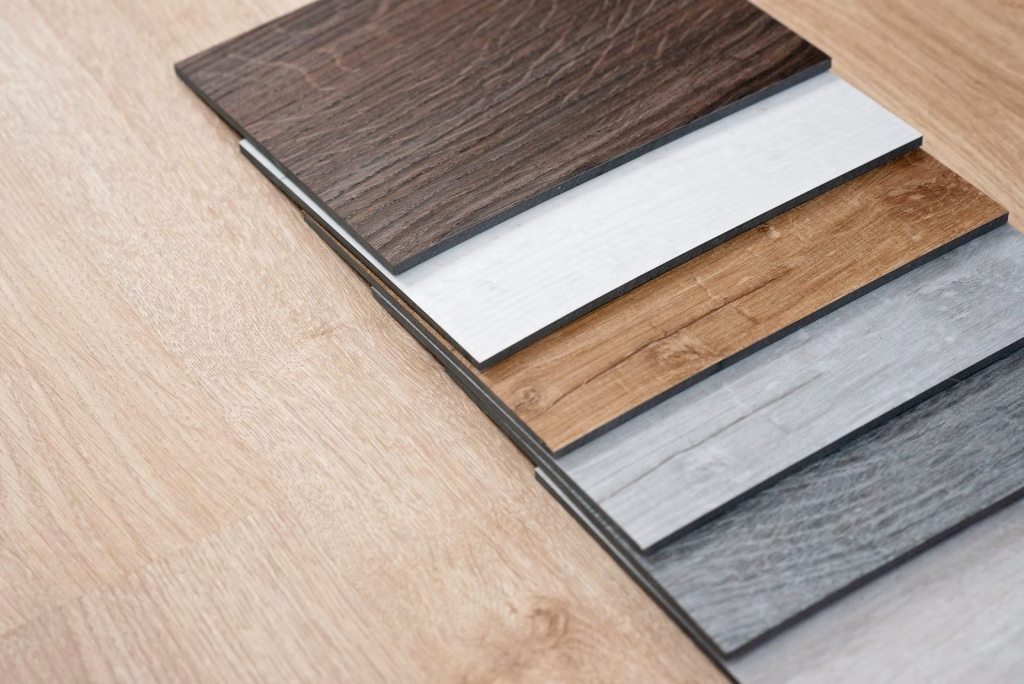
Floor coverings
Which floor covering suits floor heating?
Timber, hybrid, laminate, tiles or carpet: what can go over the panels and the height each adds.

Renovations
Adding hydronic floor heating to an existing home
No screed to pour: a 27.7 mm build-up, and the height and doorway checks to make first.
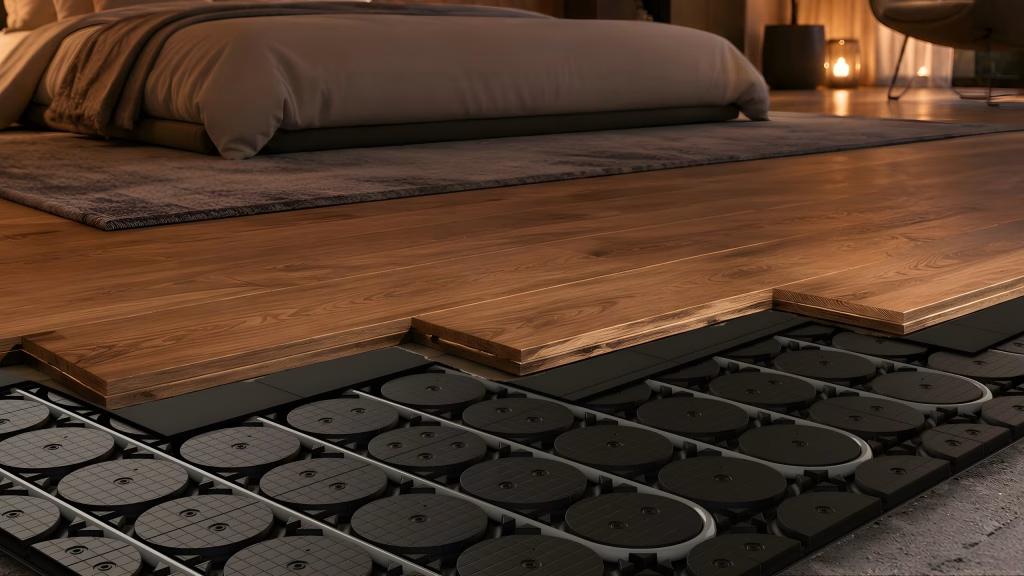
For flooring installers
Laying engineered timber over HOYA Ondol panels
Checks before you start, heating around laying, the warranty conditions and the handover.
Care
Looking after a timber floor over floor heating
Floor temperature, humidity, rugs and furniture, and what’s normal through the seasons.
Can the timber be glued to the panels?
No. The floor floats over HOYA Ondol panels, so nothing is glued to them. Adhesive goes only in the click joints between the boards. No nails, staples or screws go into the panels.
How warm will the floor feel?
Gently warm rather than hot. The timber surface is kept at or below 27 °C, which is cooler than your skin, so the warmth is even and comfortable underfoot.
Will the boards gap?
Every timber floor moves a little with the seasons. Keeping the surface temperature and indoor humidity within the limits, and changing the temperature gradually, keeps the movement small.
Can I have Blackbutt or Spotted Gum?
Not under our timber supplier’s heating warranty, which doesn’t cover eucalyptus-faced boards. Engineered oak is the approved choice, including oak on a eucalyptus core.
How much height does it add?
About 44–45 mm with 14–15 mm boards: 1.7 mm foil, the 26 mm panel, the 2 mm underlay and the boards. See floor heating build-up heights.
Can I buy the boards from another supplier?
Yes. Check that supplier’s own conditions for floor heating before you order, and send them to us so we can confirm they suit a HOYA floor.
Does it work with a heat pump?
Yes. Timber floors over HOYA Ondol are designed for flow temperatures of 35–45 °C, which suits a heat pump. See heat pumps.
What about tiles or carpet?
Tiles go on a 6 mm tile board over the panels. Carpet goes on a carpet underlay laid straight over the panels. Ask us for the specifications before you order, or compare floor coverings.
Installation and warranty
Planning a timber floor over floor heating?
Send us your floor plan and the timber you have in mind, and we’ll quote the panels, pipe and manifold for your rooms.