

Floor area and rooms
The biggest factor. More square metres means more panels and pipe, and more rooms usually means more pipe circuits on the manifold.
Every home is different, so we price each job from its plans. This guide explains what goes into the price, what a HOYA Ondol quote covers and what affects running costs, so you know what to expect before you ask.
Six things decide what a heated floor costs. We work through each one from your plans.
The biggest factor. More square metres means more panels and pipe, and more rooms usually means more pipe circuits on the manifold.
A heat pump or boiler sized for the area you heat. A heat pump costs more to buy than an electric boiler but much less to run. If you already have a suitable heat source, your installer can check it.
One manifold handles 2 to 12 circuits. Each room or zone with its own thermostat adds a thermostat and an actuator on the manifold.
The panels need a floor within 3 mm over 1 m. A floor that is out by more needs patching or self-levelling compound first.
Timber, hybrid and carpet go straight over the panels. Tiles need a 6 mm tile board on top. The floor finish itself is priced by your flooring supplier.
Everything ships from our Carrum Downs warehouse in Victoria, with freight quoted to your postcode. Laying and licensed connections are priced by your installers.
Your quote lists the full system for your floor plan, not just the floor heating panels. Some parts of the job are priced by the trades who do them.
With in-screed heating, a sand-cement screed is laid over the pipe, adding about 70–110 mm and around 120 kg/m², and the floor finish waits while it dries. In-slab heating needs a new slab, so it only suits new builds.
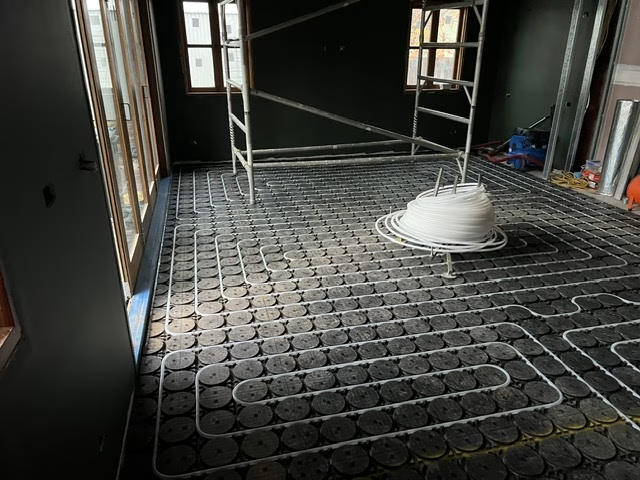
HOYA Ondol panels go straight onto your existing slab or subfloor. Nothing is poured, so there is no screed to buy, no drying time holding up the floor finish, and no new slab in a renovation. See how much height each system adds.
Running costs depend on how you heat the house, not just the floor.
A heat pump makes several units of heat for each unit of electricity it uses, which is why it is the usual choice for floor heating.
Each room can have its own thermostat. Heating only the rooms you use, when you use them, keeps the bill down.
Insulation, windows and draughts make a big difference. A well-sealed house needs less heat for the same comfort.
Your own running cost depends on your plans, your energy tariff and how you heat the house. As a worked example, take a home that needs 5,000 kWh of heat over a winter, with electricity at 40.7 c/kWh and gas at 4 c/MJ:
These figures are an example only. Send your plans and tariff and we’ll work out yours.
Because the panels are only part of the system. The heat source, manifold, number of rooms and floor preparation change the total far more than the panel price does. A quote from your plans is the only figure worth relying on.
Not necessarily. HOYA Ondol goes over your existing slab, subfloor or tiles, so there is no new slab or screed. Renovations can need extra work at doors, thresholds and skirting boards, which your builder prices.
Yes. Tell us when you send your plans, so the manifold and heat source can be sized with spare capacity for the rooms you add later.
Not always. Floor heating runs at low water temperatures. Your hydronic installer can check whether an existing heat pump or boiler suits the area you want to heat.
Send us a floor plan or a sketch with room sizes, the rooms to heat, your floor finish and your postcode. We design the layout and quote the full system.
The panels can be laid by a builder, carpenter or flooring installer, following HOYA Ondol’s installation instructions and the panel and pipe layout designed for your floor, working with your hydronic installer. Manifold, heat pump or boiler connections must be made by a licensed plumber, and electrical work by a licensed electrician. In some states, laying the heating pipe itself is also licensed plumbing work, so check with your installer. Warranty requires licensed connections. This does not limit your rights under the Australian Consumer Law.
Send us your plans. We’ll design the panel and pipe layout and quote the full system. We reply within 24 hours.