

The firebox (agungi)
A fire was lit in a firebox, often the kitchen stove, set below floor level at one side of the house. The same fire that cooked the rice also heated the rooms.
Ondol is Korea’s traditional heated floor: warmth that rises from the floor under your feet instead of blowing from a vent. HOYA Ondol brings the same idea to Australian homes with 26 mm dry panels and warm-water pipe, laid over new or existing floors with no screed to pour.
Ondol (온돌) is the Korean way of heating a home through the floor. The word is usually translated as “warm stone”. In a traditional house, the heat came from a fire at one side of the house and travelled under the floor before it left through a chimney. Korean families have heated their homes this way for centuries, which is why sitting, eating and sleeping on a warm floor is still part of everyday life in Korea.
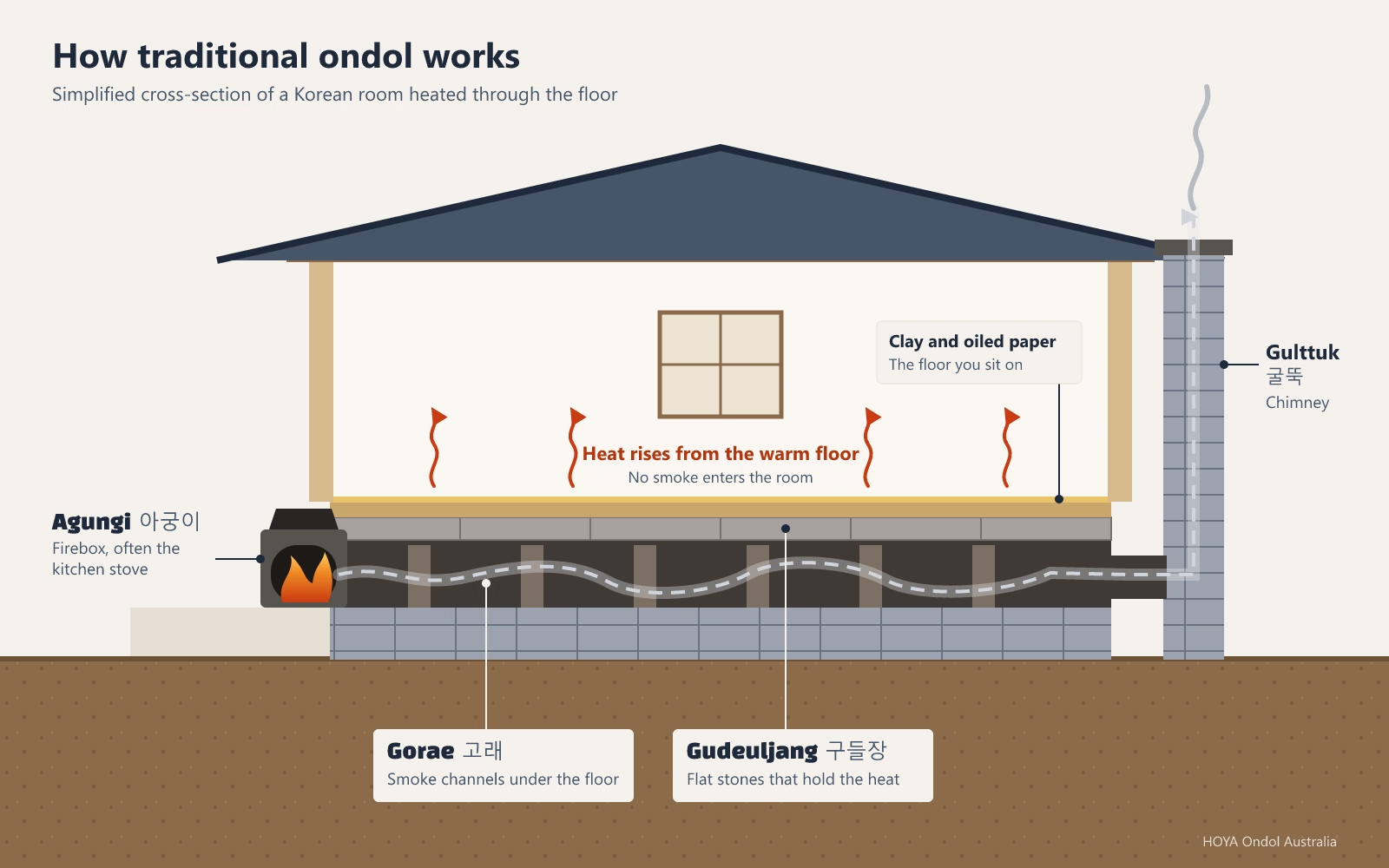
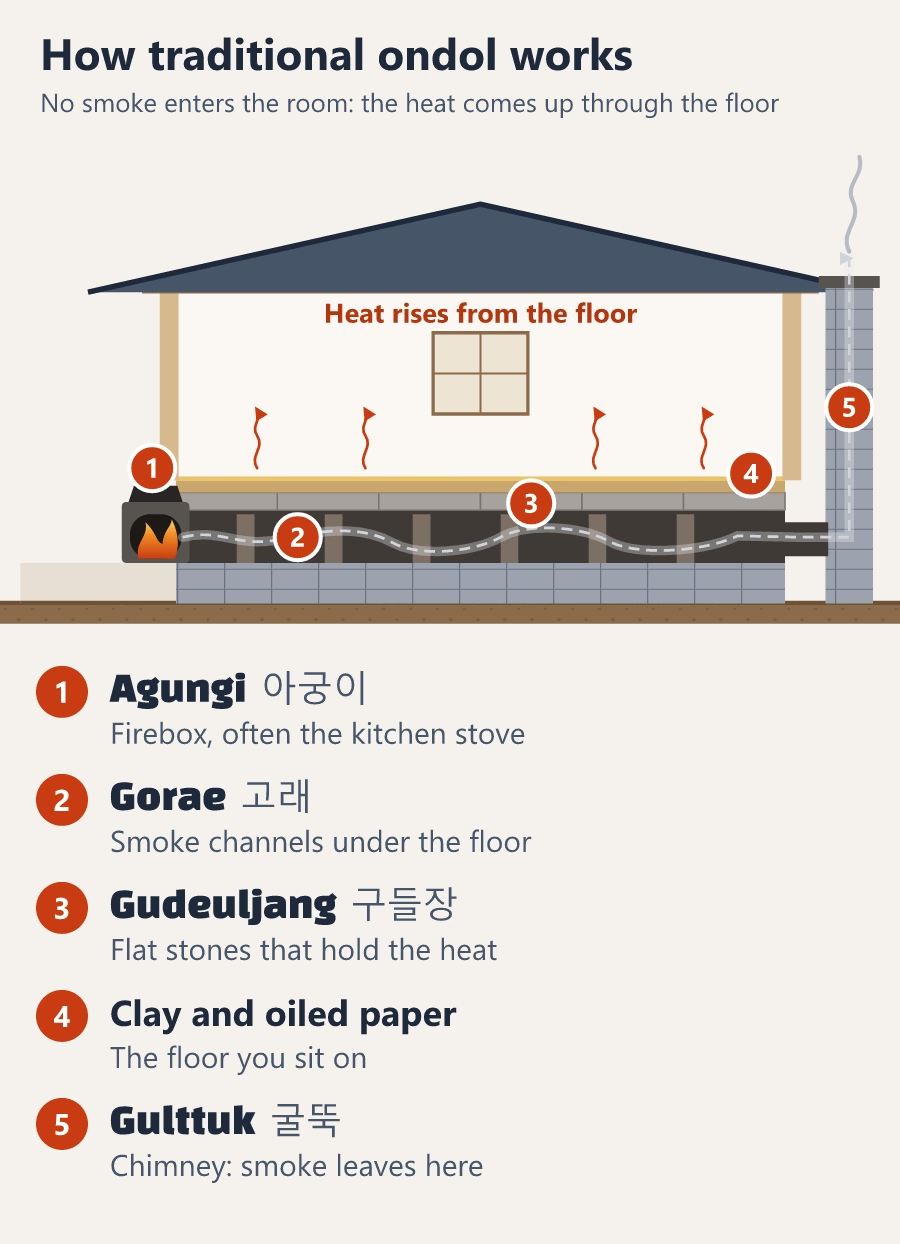
A fire was lit in a firebox, often the kitchen stove, set below floor level at one side of the house. The same fire that cooked the rice also heated the rooms.
Hot smoke drew through channels built under the floor. Flat stones laid over the channels (gudeuljang) were sealed with clay and finished with oiled paper.
The smoke left through a chimney on the far side of the house. The heavy stone floor kept giving off heat for hours after the fire died down.
Modern Korean homes kept the heated floor but replaced the fire and smoke with warm water. A boiler or heat pump heats the water, and pipes in the floor carry it through each room. HOYA Ondol is a dry-panel version of the same idea: no wet layer to pour, and a much thinner floor.
Every HOYA Ondol floor is laid on a 500 mm grid from three panel types, each 500 × 500 × 26 mm, over HOYA Ondol reflective foil. We design the panel and pipe layout for your rooms.
Straight channels. The main building block across the middle of the room, where the pipe runs back and forth.
Straight and curved channels for the turns, sides and corners. It can also cover a small or irregular room on its own.
Open, with no channels. Used near the manifold and through hallways and doorways, where several pipes travel together between raised posts.
Ondol (온돌) is the Korean word for a heated floor. It is usually translated as “warm stone”, after the stone slabs that traditional floors were built from.
A fire at one side of the house sent hot smoke through flues under a floor of stone slabs sealed with clay. The smoke left through a chimney on the other side, and the stone kept the room warm long after the fire went out.
Yes. HOYA Ondol panels are made by Hoya Hometech in Korea and supplied in Australia by HOYA Ondol Australia, part of the Australian Sun Energy Group.
No. Heated floor mats are portable mats that sit on top of the floor. HOYA Ondol is a permanent hydronic heating system built into the floor itself, under your timber, tiles or carpet. We do not sell mats.
Yes. The panels sit on the existing floor with a 27.7 mm build-up, so there is no slab to cut and no screed to pour. See adding floor heating to an existing home.
An air-to-water heat pump is the usual choice in Australia, and a gas or electric boiler also works. See heat pumps for underfloor heating.
Yes. A heated floor suits cold Australian winters, from Canberra to Victoria and Tasmania, and the low water temperatures it runs on suit heat pumps. See our projects.
More answers on our underfloor heating questions page.
The panels can be laid by a builder, carpenter or flooring installer, following HOYA Ondol’s installation instructions and the panel and pipe layout designed for your floor, working with your hydronic installer. Manifold, heat pump or boiler connections must be made by a licensed plumber, and electrical work by a licensed electrician. In some states, laying the heating pipe itself is also licensed plumbing work, so check with your installer. Warranty requires licensed connections. This does not limit your rights under the Australian Consumer Law.
Send us your floor plan and we’ll quote the HOYA Ondol panels, pipe and manifold for your rooms.