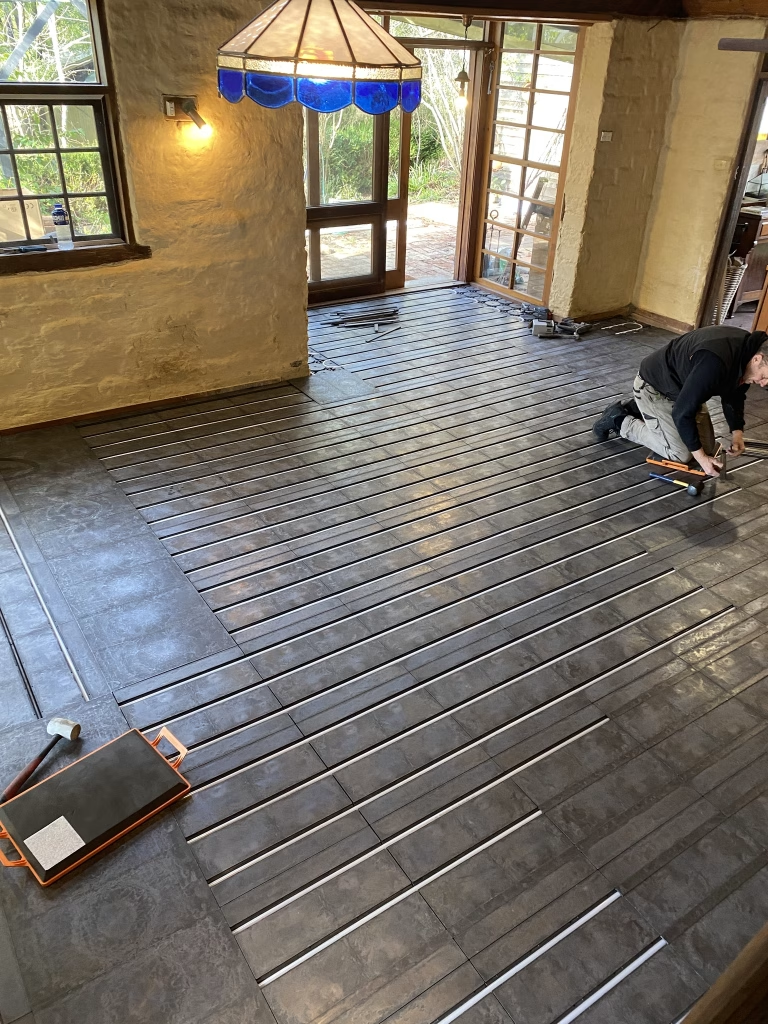
A HOYA Ondol floor goes in like any other floor build-up, with licensed trades for the connections.
Builder, carpenter or flooring installer
Prepares the floor, lays the foil and panels, presses the pipe into the channels to the layout plan, fits the covers and lays the floor finish.
Licensed plumber
Connects the manifold and heat source, pressure-tests and commissions the system. In some states, laying the heating pipe is also licensed plumbing work.
Licensed electrician
Wires the heat pump or boiler, the room thermostats and the actuators on the manifold.
What we supply
A panel and pipe layout designed for each floor, with the circuits marked
A, B and C panels and reflective foil, plus edge strips where needed
16 mm PE-RT pipe, manifold and room thermostats
Heat pumps, if the job needs one
Delivery from our Carrum Downs warehouse to site, Australia-wide
Sound, dry and within 3 mm over 1 m. Patch or self-level anything worse.
2Foil, then panels
Roll out the 1.7 mm reflective foil, then lay the panels to the layout plan.
3Pipe and pressure test
Press the pipe into the channels and pressure-test before the covers and floor go down.
4Floor finish
Float timber over the panels and never glue it. Tiles go on a 6 mm tile board.
Timber floors: use boards their maker approves for floor heating, bring the heating up gradually before the boards are laid, and keep the floor surface no hotter than 27 °C.
What the warranty needs
The manufacturer’s warranty depends on how the floor is put in.
Follow the layout
Panels and pipe are laid to the supplied layout plans, guided by the hydronic installer.
Licensed connections
Manifold, heat pump and boiler connections by a licensed plumber, and electrical work by a licensed electrician.
Register the system
Once it is commissioned, register the installation and the licensed trades who did it.
Builders use HOYA Ondol where a slab or screed system does not suit the floor or the timeline.
New homes
On a timber-framed or suspended floor, the panels go down once the subfloor is on and before the floor covering. There is no screed to pour or wait for, so the floor stays on the builder’s programme.
Extensions
A dry panel floor adds 27.7 mm, so a new extension can be heated and still meet the existing floor level with careful planning of the subfloor height.
Modular and prefab homes
The panels are light and need no wet trades, so they suit modular and prefab builds. Talk to us early about whether they go down in the factory or on site, and your hydronic installer connects the manifold and heat source once the home is placed.
Installation and warranty
The panels can be laid by a builder, carpenter or flooring installer, following HOYA Ondol’s installation instructions and the panel and pipe layout designed for your floor, working with your hydronic installer. Manifold, heat pump or boiler connections must be made by a licensed plumber, and electrical work by a licensed electrician. In some states, laying the heating pipe itself is also licensed plumbing work, so check with your installer. Warranty requires licensed connections. This does not limit your rights under the Australian Consumer Law.
Lay or connect floor heating?
If you lay floors or connect hydronic systems and would like to work with HOYA Ondol, talk to us.